

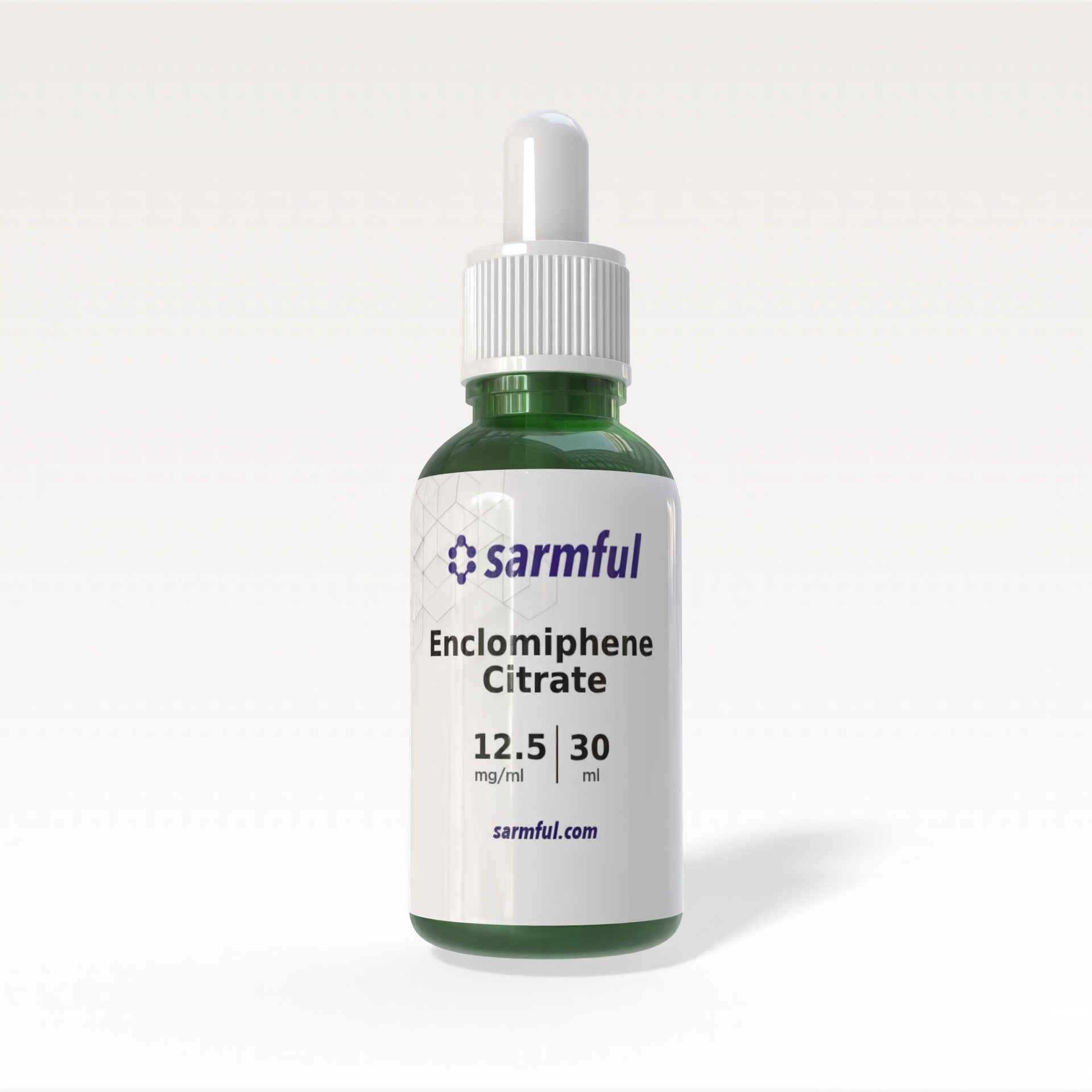
Enclomiphene is the trans-isomer of clomiphene citrate, functioning as a selective estrogen receptor modulator (SERM) with predominantly antagonist activity at estrogen receptors in the hypothalamus and pituitary. Originally developed for male hypogonadism research, enclomiphene is widely used as a tool compound in studies examining testosterone restoration and hypothalamic-pituitary-gonadal axis modulation.
Enclomiphene is a selective estrogen receptor modulator (SERM) that represents the purified trans-isomer of clomiphene citrate. Unlike the racemic mixture of clomiphene, which contains both enclomiphene and zuclomiphene isomers, enclomiphene consists solely of the therapeutically active trans-isomer with a shorter half-life and more favorable pharmacological profile.
As a SERM, enclomiphene acts primarily as an estrogen receptor antagonist in the hypothalamus and pituitary gland. By blocking estrogen receptors in these tissues, it prevents negative feedback inhibition of gonadotropin release, leading to increased production of luteinizing hormone (LH) and follicle-stimulating hormone (FSH). This mechanism makes enclomiphene particularly valuable for research into endogenous testosterone production and hormonal recovery.
Enclomiphene Name and Classification
Enclomiphene is identified by its chemical designation as the trans-isomer of clomiphene citrate. The compound is also known by its developmental name enclomiphene citrate or (E)-clomiphene in scientific literature.
Enclomiphene belongs to the class of selective estrogen receptor modulators, compounds that exhibit tissue-selective estrogen receptor agonist or antagonist activity. It was originally developed by Repros Therapeutics for investigation as a treatment for secondary hypogonadism in men.
Mechanism of Action
Enclomiphene functions by selectively blocking estrogen receptors in the hypothalamus and pituitary gland, disrupting the negative feedback loop that estrogen normally exerts on gonadotropin-releasing hormone (GnRH) and gonadotropin secretion.
Key mechanistic features include:
- Estrogen receptor antagonism in hypothalamic and pituitary tissues
- Increased GnRH secretion from the hypothalamus
- Elevated LH and FSH production from the pituitary gland
- Stimulation of endogenous testosterone synthesis in Leydig cells
- Preservation of spermatogenesis through maintained FSH levels
In experimental models, enclomiphene demonstrates the ability to restore testosterone production without directly introducing exogenous androgens, making it useful for studying the body's natural hormonal regulation mechanisms.
Benefits in Research
In preclinical and clinical research settings, enclomiphene has been studied for its effects on male reproductive hormones and hypothalamic-pituitary-gonadal axis function. Published studies suggest that enclomiphene may:
- Increase endogenous testosterone production in hypogonadal models
- Elevate LH and FSH levels through hypothalamic-pituitary stimulation
- Restore hormonal balance following suppression of the HPG axis
- Maintain spermatogenesis while increasing testosterone levels
- Provide an alternative mechanism for studying testosterone restoration
These findings from controlled experimental models help researchers understand SERM-mediated hormonal regulation and the mechanisms of endogenous testosterone recovery.
Enclomiphene Dose in Research Studies
Most available data on enclomiphene dose comes from human clinical trials and preclinical research. Published studies report varying protocols depending on research objectives and population studied.
Typical experimental dosing ranges:
- 12.5 mg to 25 mg administered once daily in clinical studies
- 25 mg daily most commonly used in male hypogonadism research
- 12.5 mg daily investigated as a lower-dose alternative
- 50 mg daily evaluated in some trials for comparison
Dosing considerations in research:
- Oral administration is standard due to good bioavailability
- Once-daily dosing appears sufficient based on pharmacokinetic profile
- Duration of administration varies from short-term (weeks) to extended protocols (months)
- Lower doses may provide hormonal benefits with reduced side effect profiles
The enclomiphene dose used in research directly impacts the degree of LH and FSH elevation, testosterone response, and overall hormonal outcomes, making dose selection critical for experimental design.
Enclomiphene Protocol
One important application of enclomiphene involves enclomiphene protocol research for hormonal recovery following suppression of the hypothalamic-pituitary-gonadal axis. This area of study examines how SERMs can restore endogenous hormone production after periods of exogenous androgen administration.
Post-suppression recovery protocols studied:
Standard recovery protocol:
- 12.5-25 mg daily for 4-6 weeks following cessation of suppressive agents
- Initiation typically begins immediately after clearance of exogenous compounds
- Duration adjusted based on degree and length of prior suppression
Extended recovery protocol:
- 12.5 mg daily for 6-8 weeks in cases of prolonged suppression
- May include tapering approach in final weeks
- Monitoring of LH, FSH, and testosterone levels throughout protocol
Research considerations:
- Timing of initiation relative to cessation of suppressive agents
- Duration of protocol based on severity of hormonal suppression
- Dosing strategy (standard vs. tapering approaches)
- Combination with other recovery-supporting compounds in some studies
The enclomiphene protocol for post-cycle recovery research provides valuable data on SERM-mediated restoration of the HPG axis following suppression, helping researchers understand optimal strategies for hormonal normalization.
Enclomiphene Side Effects in Research and Clinical Studies
Because enclomiphene modulates estrogen receptor signaling and influences hormonal pathways, enclomiphene side effects observed in research depend on dose and individual response. In clinical trials and research models, investigators monitor for:
Hormonal and reproductive effects:
- Elevated estrogen levels due to increased aromatization of elevated testosterone
- Testicular growth or discomfort in some subjects due to increased gonadotropin stimulation
- Changes in libido, typically increases but variable individual responses
Visual and ocular observations:
- Visual disturbances reported in some subjects, though less common than with racemic clomiphene
- Blurred vision or light sensitivity in rare cases
- Generally reversible upon discontinuation
Mood and cognitive effects:
- Mood changes or emotional lability in some research participants
- Potential anxiety or irritability linked to hormonal fluctuations
- Individual variability in psychological responses
Physical observations:
- Headaches reported in some clinical trial participants
- Hot flashes or temperature regulation changes
- Gastrointestinal symptoms including nausea in some subjects
- Mild elevations in liver enzymes in rare cases
Metabolic parameters:
- Changes in lipid profiles, typically favorable compared to exogenous testosterone
- Effects on insulin sensitivity under investigation
- Generally well-tolerated metabolic profile
Understanding these enclomiphene side effects helps researchers establish safe dosing parameters and monitor for adverse events in experimental protocols. The side effect profile of enclomiphene appears more favorable than racemic clomiphene due to the absence of the zuclomiphene isomer, which has a longer half-life and accumulates with repeated dosing.
Enclomiphene vs Clomiphene
Enclomiphene differs from standard clomiphene citrate in important ways. Clomiphene citrate is a racemic mixture containing approximately 62% zuclomiphene and 38% enclomiphene. The zuclomiphene isomer has a longer half-life (approximately 30 days) and accumulates with repeated administration, potentially contributing to adverse effects.
Key differences:
- Enclomiphene contains only the trans-isomer with favorable pharmacokinetics
- Shorter half-life reduces accumulation and side effect risk
- More predictable dose-response relationships in research
- Potentially improved tolerability profile in clinical studies
Oral Administration in Research
Enclomiphene demonstrates good oral bioavailability in human studies, making oral administration the standard route in research protocols. This allows researchers to examine sustained effects on hormonal parameters over extended treatment periods with convenient daily dosing.
The oral route facilitates investigation of enclomiphene's pharmacokinetic properties, including absorption characteristics, peak plasma concentrations, and steady-state dynamics during chronic administration.
Human Clinical Trials
Enclomiphene has been evaluated in multiple human clinical trials for secondary hypogonadism in men. Phase II and Phase III trials demonstrated significant increases in testosterone levels while maintaining spermatogenesis. The compound showed efficacy in restoring testosterone to normal ranges in hypogonadal men with generally favorable tolerability.
Despite positive clinical trial results, enclomiphene has not received regulatory approval in major markets as of this time. Development programs have faced regulatory and commercial challenges, though the compound remains available for research purposes.
Why You Should Buy Enclomiphene from Sarmful
If you are looking to buy enclomiphene for research purposes, Sarmful offers enclomiphene for sale in liquid form, repared to support consistent and reliable experimental work.
When you buy enclomiphene from Sarmful, you benefit from:
- Third-party lab testing and in-house verification for purity and concentration
- EU and US domestic shipping for reliable delivery to your research facility
- Convenient payment methods designed for seamless research procurement
- Research-grade quality formulated to meet the standards of serious laboratory work




Reviews
There are no reviews yet.